Direct answer
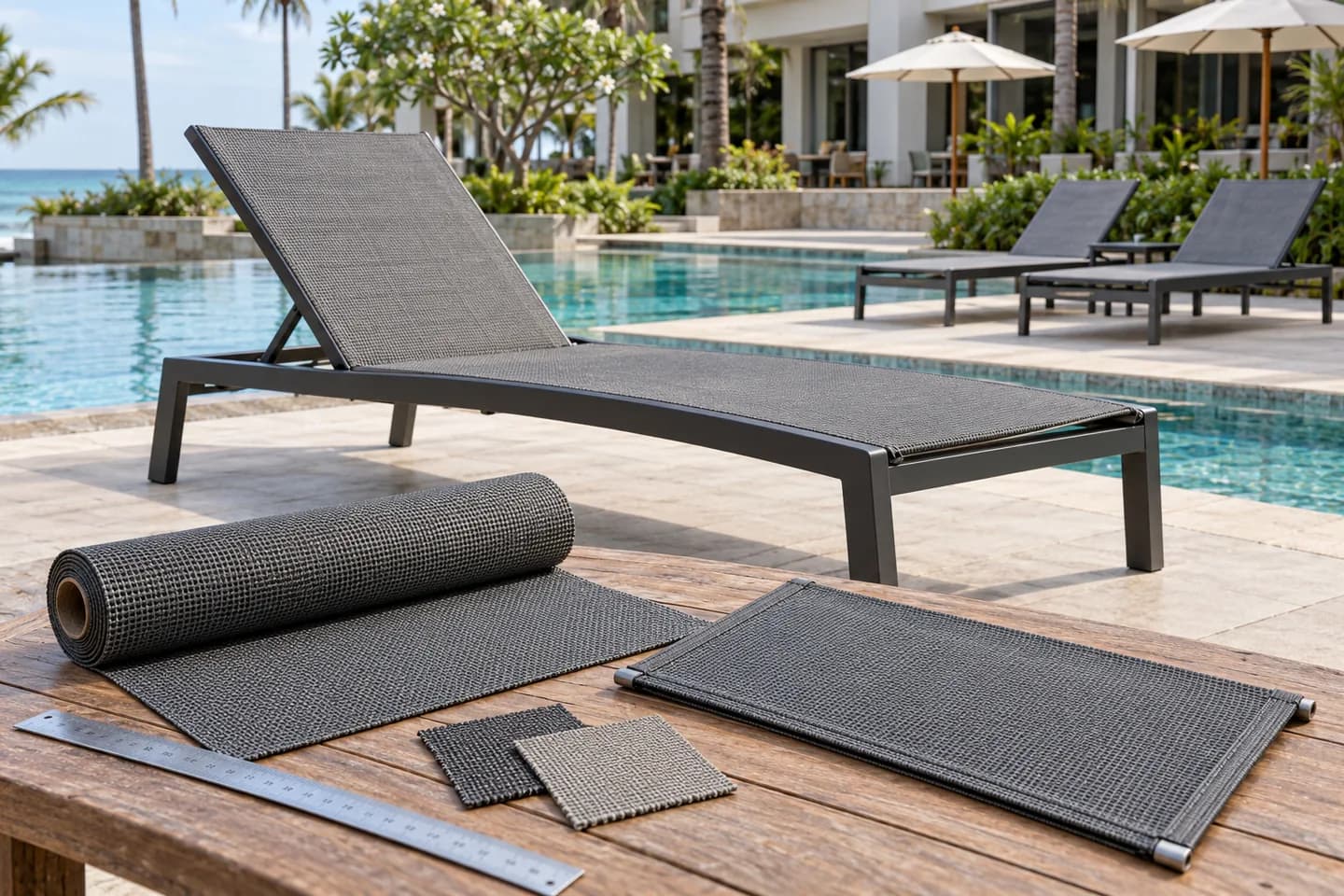
Plan a hotel replacement sling program around the furniture models and service schedule. Inspect the frames first, separate compatible models into batches, define whether you are buying fabric or finished slings, and approve a complete refurbished chair before ordering the full quantity. Calculate material and spares from the approved panel pattern, then schedule installation around the number of seats the property must keep available. A successful purchase delivers usable furniture back to service, with a documented specification for future replacements.
A resort may have identical-looking loungers bought in different years, dining chairs with separate seat and back panels, and a pool terrace that cannot close during the season. Ordering one color of mesh for the whole property does not resolve those differences.
This guide is for hotel purchasing teams, facilities managers, furniture distributors and fabricators planning a coordinated refurbishment. It covers the purchasing and approval process; installation details must follow the furniture manufacturer's instructions for the specific model.
Audit the furniture before ordering fabric
Start with a count of actual furniture, grouped by manufacturer, model and construction revision where available. Include photographs of labels, attachment details and the complete unit. A marketing collection name alone may not identify the required replacement.
Tropitone's product care guidance asks customers to identify model numbers when ordering replacement slings and provides separate instructions for different furniture designs. That is a useful reason to make model identification the first purchasing step.
Use a register that can move between facilities, procurement and the fabricator:
| Record | What to include | Purchasing purpose |
|---|---|---|
| Asset group | Location, manufacturer, model and purchase year if known | Keep different furniture generations separate |
| Construction | One-piece sling, separate panels, padded or other design | Identify the component that must be replaced |
| Quantity | Total units, units needing work and serviceable spares | Establish the refurbishment scope |
| Frame assessment | Rails, joints, hardware, adjustment mechanisms and defects | Decide whether sling replacement is appropriate |
| Reference | Label photos, drawing, approved sample or manufacturer part number | Reduce ambiguity in quotations |
| Delivery phase | Zone, required return-to-service date and storage location | Plan installation without unnecessary disruption |
Have the manufacturer or a qualified repair provider assess questionable frames. A new sling cannot correct a damaged rail, unstable joint or defective reclining mechanism. Keep unsafe furniture out of service; do not include it in the usable seating count while a repair decision is pending.
Classify each group as suitable for sling replacement, requiring additional repair assessment, or a candidate for complete replacement. Make that decision before committing to bulk fabric.
Choose what you are actually buying
The phrase "replacement sling fabric" can describe three different purchasing routes. Compare quotations on the same scope.
| Route | What the buyer receives | What still needs to be arranged |
|---|---|---|
| Fabric by the roll | Material to an agreed construction, color and usable width | Pattern development, cutting, sewing or other approved fabrication, hardware and installation |
| Finished replacement slings | Panels made for an identified model and approved specification | Frame inspection, installation and acceptance checks |
| Complete replacement furniture | Finished chairs or loungers | Delivery, assembly where required, placement and disposal of retired units |
Roll fabric may suit a distributor or hotel group with an experienced fabrication partner. Finished slings may simplify a smaller, well-identified replacement batch. Neither route is automatically cheaper after labor, transport and rework are included.
Confirm who owns the pattern, who approves fit, and who handles a component that does not fit. If several companies are involved, name one person responsible for coordinating the complete trial unit.
Build a model-specific replacement specification
Ask for the furniture maker's replacement part details or measurement procedure first. Keep frame dimensions, finished panel dimensions and cutting dimensions clearly separated: they serve different purposes.
An old sling can help identify construction and attachment details, but stretching, damage or previous alterations can make it an unreliable cutting template. Have the fabricator verify the pattern against the actual frame and approved installation method. There is no universal amount to subtract from a chair measurement to create the correct tension.
For each model, agree on:
- Panel identity, count and drawing revision, including separate seat and back pieces.
- Material reference, weave direction, usable width and approved color.
- Edge construction, thread and seam details where applicable.
- Compatible attachment components and responsibility for supplying them.
- Dimensional tolerances and the method used to check finished panels.
- Sample quantity, fit approval and any required finished-furniture testing.
Not every outdoor mesh is suitable for a load-bearing sling. Phifer's sling replacement guide explains why this application requires fabric engineered for strength and dimensional stability under tension. A similar appearance is not evidence of equivalent performance.
Ask the supplier for information relevant to the proposed material and end use. A fabric test report does not, by itself, establish the performance of a chair assembled with different seams, rails or hardware. Our sling chair fabric guide provides additional material-selection context.
Approve a complete chair before releasing the batch
A swatch can support color and texture approval. It cannot demonstrate whether the finished panel fits the frame or whether the lounger operates correctly after installation.
Arrange a pilot for each distinct construction that needs approval. Use the proposed production fabric and fabrication method, fitted by the responsible service provider to a representative, inspected frame. Record any differences from the intended bulk specification.
The approval record should cover:
- Identity: model, panel drawing, material code, color reference and component details.
- Fit and assembly: confirmation against the manufacturer's requirements, including panel retention and edge finishing.
- Operation: adjustment and folding functions, clearances and other model-specific checks.
- Appearance: weave orientation, seam alignment and comparison with the approved physical reference.
- Acceptance: required inspections or tests, results, approver and conditions for release.
Do not use guests to test an unapproved refurbishment. Have the responsible manufacturer or qualified provider define the acceptance checks and determine whether additional testing is required for the intended commercial use.
Retain a signed specification and an approved reference. If the trial fails, resolve the cause and repeat the affected checks before cutting the main batch. For visual consistency between deliveries, follow a documented color matching and sample approval process.
Plan quantities by model and panel
Count furniture units, finished panels and fabric length separately. A lounger with two sling panels is one asset but two replacement components. Spare panels also need model identification; a spare for one frame may not fit another.
For finished slings, calculate the scheduled replacement panels plus the agreed spares, then subtract verified usable stock. Choose the spare quantity using repair history, replenishment lead time, storage capacity and the consequences of losing seating. A fixed spare percentage is not a substitute for those inputs.
For roll fabric, ask the fabricator for a cutting layout based on usable width, panel orientation and approved seam allowances. Add identified needs for sampling, setup and expected cutting loss. If the supplier changes roll width, revisit the layout before assuming the original fabric quantity still works.
Worked example: a phased lounger refurbishment
The following numbers are illustrative, not a recommended spare level or installation rate.
A property has 120 serviceable loungers of one approved model. Facilities identifies 72 for planned sling replacement. Each has a separate seat and back panel. The team chooses four complete spare sets and confirms that two compatible, unused sets are already in stock.
| Calculation | Result |
|---|---|
| Scheduled replacement sets | 72 |
| Additional spare sets selected by the property | 4 |
| Verified usable sets in stock | 2 |
| New sets to purchase: 72 + 4 - 2 | 74 |
| Panels per set | 2 |
| New panels to purchase: 74 × 2 | 148 |
If operations requires at least 96 loungers available, the theoretical limit is 24 out of service at once. Three batches of 24 could cover the 72 planned refurbishments, provided no other units become unavailable. Facilities should leave an operational buffer and confirm actual workshop capacity before accepting that schedule.
This calculation determines finished components. It does not determine roll length; the fabricator still needs the approved cutting layout.
Schedule backward from the return-to-service date
The final delivery date is not the date the hotel can necessarily use the furniture. Allow time for receiving inspection, installation, corrections and acceptance before reopening a zone.
Build the schedule backward through these milestones:
- Furniture returned to service after acceptance.
- Installation completed and any defects resolved.
- Components received, counted and matched to model groups.
- Shipment delivered after the agreed transport and clearance process.
- Production completed against the approved specification.
- Pilot approved and final quantities released.
- Inventory, frame assessment and quotation scope confirmed.
Request lead times for sampling and bulk production separately. Confirm whether quoted lead time begins at deposit, material availability, drawing approval or another milestone. Obtain current commitments from the parties involved rather than planning around a generic industry estimate.
Label deliveries by model, panel and installation phase. Keep removed units, approved units and items awaiting review in distinct areas so unfinished work cannot accidentally return to guest use.
Compare the cost per accepted refurbished unit
Price per meter is useful for comparing equivalent materials, but it is not the final decision metric for a refurbishment program.
Build the project estimate from fabric or finished panels, sampling, fabrication, attachment parts, freight, applicable import charges, installation, inspection and disposal. Include temporary seating or workshop arrangements if the project needs them. Keep spare stock visible as a separate budget line.
Divide the defined refurbishment costs by the number of units accepted back into service. Use consistent treatment of spares and one-time development costs across quotations. Compare this with a complete-furniture replacement option using an equivalent delivery and installation scope.
Replacement slings can preserve usable frames, but do not promise a universal saving, service life or environmental benefit. The outcome depends on frame condition, successful fabrication, installation cost and subsequent use.
For broader decisions about furniture environments and maintenance demands, see our hotel and resort fabric selection guide.
Keep a record for the next replacement cycle
After acceptance, link each model group to its approved drawing, material reference, supplier, batch, installer and service date. Label spare sets with the model and revision, and store them according to the supplier's guidance.
Record failures precisely: a torn panel, loose attachment, damaged rail and stained surface require different responses. This history can help the next buyer distinguish material needs from fabrication or maintenance issues.
Give the housekeeping team the approved care instructions for the specific material and assembly. Our outdoor mesh care guide can help structure that handover; the manufacturer's product-specific instructions remain the reference.
Send a replacement sling fabric RFQ that can be quoted
An effective inquiry makes the unresolved questions visible. Include:
- Property location, operating environment and intended furniture use.
- Manufacturer, model, photographs and available part references.
- Whether the inquiry is for roll fabric, finished panels or another scope.
- Approved material reference, or the sample needed to evaluate alternatives.
- Usable width and estimated fabric quantity, or finished panel quantities by model.
- Color breakdown, pilot requirements and acceptance responsibilities.
- Target delivery phases, destination and requested quotation basis.
Use the custom outdoor fabric RFQ checklist to organize the commercial details. AOLEADER can discuss material requirements for outdoor furniture applications. Identify any need for finished replacement slings or installation explicitly so the supply scope can be confirmed; a fabric inquiry does not establish compatibility with a particular furniture brand.
FAQ
Can we use the same mesh for every chair and lounger?
Possibly, but approve it for each relevant construction. Different furniture groups can require different panel patterns, attachments or material behavior. A common color does not make the components interchangeable.
Should we order using measurements from the old sling?
Use the manufacturer's procedure or have the fabricator establish a verified pattern. An old sling is useful reference material, but its dimensions may have changed in service. Confirm fit on the actual model before releasing bulk work.
How much spare fabric or how many spare slings should we buy?
Base the decision on model quantities, past replacement demand, replenishment time and storage conditions. For roll fabric, use the approved cutting layout. For finished slings, identify spares by model and panel rather than ordering an unallocated percentage.
Is replacing slings always more economical than buying new furniture?
No. Compare the total installed cost and condition of the existing frames with a complete replacement option. Extensive frame repairs, uncertain compatibility or repeated rework may change the result.
Can the refurbishment happen while the resort stays open?
It can be planned in phases when sufficient approved furniture remains available and the work area is controlled. Agree on the minimum seating requirement, batch size and release checks before scheduling. Keep units awaiting repair or acceptance out of guest service.