Direct answer
Choose hotel outdoor furniture fabric by furniture construction, operating zone and maintenance routine. Poolside sling seating needs a fabric approved for the frame and tensioning system; cushioned lounge seating needs a suitable cover, cushion construction and drying plan. Compare product-specific evidence, trial a complete furniture unit and confirm replacement arrangements before placing a large order. Color and price should be evaluated within that brief.
A resort can use one coordinated color palette without using one fabric everywhere. A sun lounger beside a pool, a dining chair exposed to food spills and a sheltered balcony sofa have different jobs. Choosing solely from a sample book can miss the differences that housekeeping and maintenance teams will encounter after installation.
This guide is for hospitality procurement teams, outdoor furniture manufacturers and project suppliers specifying seating for hotels and resorts. Its focus is the buying decision across a property: which requirements to document, how to review samples and what to prepare for ongoing service.
Map the property before choosing the material
Create a furniture schedule by zone. Record the furniture model, quantity, exposure, cleaning access and how the furniture is handled. Then group areas with genuinely similar requirements. A sheltered terrace and an exposed pool deck should not automatically share a specification just because their chairs look similar.
| Operating zone | Questions for the property team | What to review in a sample or mock-up |
|---|---|---|
| Pool deck and sun loungers | Will guests use the seating while wet? Where can staff rinse and dry it? | Drainage, time until ready for use, comfort, frame fit and the approved cleaning method |
| Outdoor dining and bars | Which food and drink spills are likely? Are chairs stacked between services? | Cleanup effort, visible residue, seams and contact points during stacking |
| Shaded lounges and cabanas | Are cushions left outside? Who moves or stores them during rain? | The complete cushion assembly, access to covers, drying and handling |
| Guest balconies | Can housekeeping reach all surfaces? Can an individual cover or panel be replaced? | Cleaning access, removable components and consistency across room groups |
| Exposed coastal terraces | How are sand and salt deposits removed? Where is furniture stored? | The proposed maintenance routine and the compatibility of fabric, frame and fittings |
Do not assume that “outdoor use” defines all these conditions. Add the actual cleaning products, storage arrangements and seasonal operating pattern to the schedule. These details help suppliers propose a material for a specific use rather than an unspecified outdoor setting.
Match the fabric to the furniture construction
The first distinction is whether the fabric supports the user under tension or covers a supporting cushion. That affects what you ask the material supplier and furniture manufacturer to approve.
Sling chairs and sun loungers
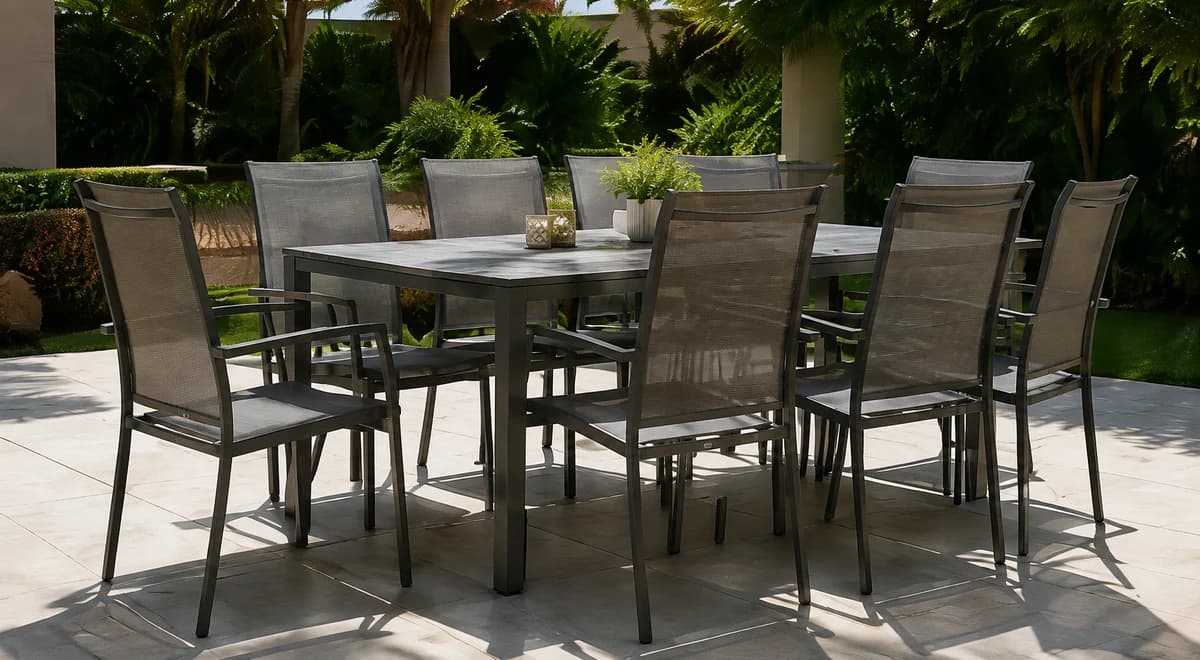
For sling seating, the fabric works with the frame, attachment system and panel geometry. PVC-coated polyester mesh is one material direction to investigate, but the exact construction must be suitable for the proposed chair. Ask about fabric orientation, usable width, panel dimensions and the sewing or joining method.
Phifer's outdoor furniture fabric guidance distinguishes fabrics intended for sling applications from softer cushion applications. That distinction is useful when preparing a brief; it does not establish that another supplier's visually similar fabric has the same properties or approved uses.
A small swatch helps with appearance and feel. It cannot show whether a long seat panel remains correctly fitted to your frame. For the detailed material review, see our guide to mesh for sling chairs and sun loungers.
Cushioned lounge furniture
Review the outer fabric together with the cushion filling, liner, seams, underside and any removable cover. Ask the furniture supplier to explain where water can enter, how it leaves and how the assembled cushion should dry. A description of the cover fabric alone does not answer those questions.
Outdoor upholstery ranges may include acrylic, olefin or polyester constructions. Specify the intended use and request evidence for the selected product instead of treating the fiber name as a complete performance specification. Do not substitute an upholstery cover fabric into a tensioned sling seat without the furniture manufacturer's approval.
Decorative woven panels
A fabric used on a decorative back panel or side panel may have a different role from the seat. Mark that role on the drawing. If several materials are used on one chair, identify each separately in the specification and sample approval record.
Agree on the cleaning routine before approving the color
Invite housekeeping or facilities staff into the sample review. Ask them to describe how outdoor seating will actually be cleaned during a busy service period, including where rinse water is available and how much time is available before a chair returns to use.
Get written care instructions for the exact fabric and finished furniture. Confirm the permitted cleaner, dilution, application method, contact time where relevant, rinsing and drying process. If the property uses a particular disinfectant or stain remover, provide its product details and ask the supplier to confirm compatibility.
Manufacturer instructions can be quite specific. For example, Sunbrella's guidance for its own Sling fabrics calls for rinsing, gentle cleaning and air drying, and cautions against abrasive cleaning methods. This is an example of product-specific guidance, not a cleaning recipe for every outdoor fabric. Do not transfer chemical concentrations or bleach permissions from one material range to another.
Run a small, documented cleaning trial on a supplier-approved sample before treating installed furniture. Include realistic spills relevant to the zone, use only the approved method and record the result after drying. Check changes in color, texture, surface feel and visible residue as well as whether the original mark was removed.
A fabric that cleans acceptably only through a procedure the property cannot reliably perform is a poor operational fit. Resolve that mismatch during sampling, when changing the material or maintenance plan is still practical.
Read performance evidence in context
Ask what was tested, how it was tested and which result was measured. A report should identify the sample well enough to connect it to the proposed construction. A general catalog statement is not a substitute for that connection.
| Performance question | Information to request | What still needs a project review |
|---|---|---|
| How does appearance change with light exposure? | Test method, exposure conditions, duration and the measured color or appearance change | Whether the evidence addresses the intended location and selected color |
| How does the surface resist rubbing? | Abrasion method, test endpoint, result and fabric identification | Wear at seams, edges, frame contacts and stacking points |
| Will a sling remain correctly fitted? | Relevant dimensional or mechanical data and the proposed frame trial | Panel orientation, tensioning, attachments and the finished chair |
| Could color transfer become an issue? | Available wet and dry rubbing or color-transfer data for the selected fabric | Contact with towels, clothing and the approved maintenance routine |
| Is the cleaning process compatible? | Product-specific care instructions and relevant compatibility evidence | Repeated cleaning under the property's actual procedure |
For upholstery, the Association for Contract Textiles explains that higher abrasion results do not necessarily mean longer service life. Its guidance also distinguishes flat abrasion tests from other wear encountered on furniture. Use abrasion evidence as one part of the review; do not treat it as proof of a sling seat's structural suitability or a complete measure of hotel-service durability.
Similarly, ask for more than an unexplained number of “UV hours.” ASTM's overview of G154 describes a practice for controlled exposure and explains that application-specific conditions and evaluation of changes are also needed. A duration without those details is an incomplete basis for comparing two fabrics.
Ask the project team which fire, chemical or other requirements apply to the furniture and destination, then request the relevant evidence. Avoid treating a report for one submitted sample as approval for every color, construction or finished assembly. Our quality and documentation page provides a starting point for product-specific questions.
Run a complete-furniture pilot with the operating team
After reviewing material samples, arrange a limited trial using complete, furniture-manufacturer-approved units. Include the proposed frame, attachments, seams, cushion components and color. A trial unit built with different parts can conceal the issue you are trying to evaluate.
Agree on the observations and acceptance criteria before the trial begins. This is a practical operating review, alongside any required furniture testing; it is not a way to predict years of service from a short trial.
- Record the starting condition. Label the fabric and furniture version, photograph the assembly and retain an unused reference sample.
- Check the intended tasks. Review comfort, cleaning, drying, moving, stacking and storage where these apply to the zone.
- Capture observations consistently. Use the same cleaning procedure and record relevant conditions so differences between samples can be interpreted.
- Resolve issues before approval. If the fabric, frame or joining method changes, identify the revision and repeat the affected checks.
Use a simple record rather than relying on a general comment such as “the sample looks good.”
| Review item | Useful record | Team to involve |
|---|---|---|
| Appearance and comfort | Observations on the complete unit in its intended setting | Design and operations |
| Cleaning practicality | Procedure, staff time and appearance after drying | Housekeeping |
| Ready-for-use condition | Drying observations after the agreed cleaning or wetting scenario | Operations |
| Fit and assembly | Any looseness, distortion, seam issue or contact-point damage | Furniture supplier and maintenance |
| Serviceability | Steps, tools and access needed to replace a cover or panel | Maintenance and procurement |
Separate mandatory acceptance criteria from preferences. A sample should not pass because an attractive color offsets an unresolved fit or cleaning problem in an averaged score.
Plan replacements before placing the main order
Ask how a worn or damaged panel would be replaced while the rest of the furniture remains in service. Confirm whether replacement material, cut panels or complete covers can be supplied, who performs the work and what information a future reorder will require.
Keep an approval file containing the furniture model, panel drawing, fabric orientation, construction reference, color reference, approved sample and revision date. Add the agreed care instructions and relevant batch information when the order arrives. This makes a later inquiry more precise than “the same gray mesh we bought last year.”
Discuss future availability and color variation explicitly. A retained sample is a comparison reference, not a guarantee of an identical future batch. Ask how the supplier handles replacement matching and whether the property should plan replacements by individual unit, furniture group or zone.
Set spare quantities using your installed furniture count, supplier lead time, storage conditions and expected maintenance access. There is no useful universal spare percentage for every property. Ask which storage conditions are appropriate for the spare fabric or finished panels.
For budgeting, compare acquisition, fabrication, routine care, replacement labor and expected downtime over the same planning period. Document the assumptions; do not justify a price difference with an unverified service-life promise.
What to send in a hospitality fabric inquiry
Turn the decisions into a short project brief. Include:
- The property location, operating zones and intended furniture models.
- Photos or drawings showing whether the fabric forms a sling, cushion cover or decorative panel.
- Quantities by model and color, with the first order separated from any future rollout.
- The cleaning products and maintenance procedure the property intends to use.
- Required performance evidence and any project-specific acceptance criteria.
- The sample-review schedule, required delivery date and replacement-support questions.
Use our custom outdoor fabric RFQ checklist to structure the commercial request. To discuss material directions, send the brief through the project inquiry form and explore the outdoor furniture application page. AOLEADER can review the application and material requirements; specifications, sample availability, documentation, MOQ and timing are confirmed for the individual inquiry.
FAQ
What is the best outdoor furniture fabric for a hotel?
There is no single choice for every furniture type and operating zone. Start by separating tensioned sling seating from cushion upholstery, then assess cleaning, exposure, comfort and replacement needs. Approve the specific fabric on the proposed furniture rather than choosing from the material name alone.
Can one fabric be used throughout a resort?
Possibly, if its intended uses and project review support all the applications. A more practical approach may be to coordinate colors across different constructions. Confirm each furniture use separately, even when the visual palette is shared.
Does the highest abrasion rating mean the most durable fabric?
No. Abrasion is one measured property under defined conditions. Review its relevance alongside fit, edge and seam wear, cleaning compatibility, exposure and the complete furniture construction. It should not be converted directly into a service-life claim.
Can poolside furniture fabric be cleaned with bleach?
Only where the instructions for the specific fabric and finished furniture permit it, using the stated procedure. Confirm compatibility with other components as well. A bleach-cleaning instruction for another brand or fabric range is not sufficient authorization.
Should the hotel review fabric samples or finished furniture?
Both serve a purpose. Swatches support initial appearance, feel and documentation reviews. A complete approved furniture sample lets design, housekeeping and maintenance assess the assembly and everyday operating tasks before a wider purchase.