Direct answer
For a hot, humid destination, do not approve PVC-coated polyester mesh on a “weather-resistant” label alone. Define where the finished product will sit, then request construction details, test methods and results for the proposed fabric. Check the coating and weave, strength in both directions, performance after heat and wet-weather exposure, color change, cleanability and fit in a finished-product pilot. Agree on acceptance criteria before testing and keep the approved sample tied to the production lot.
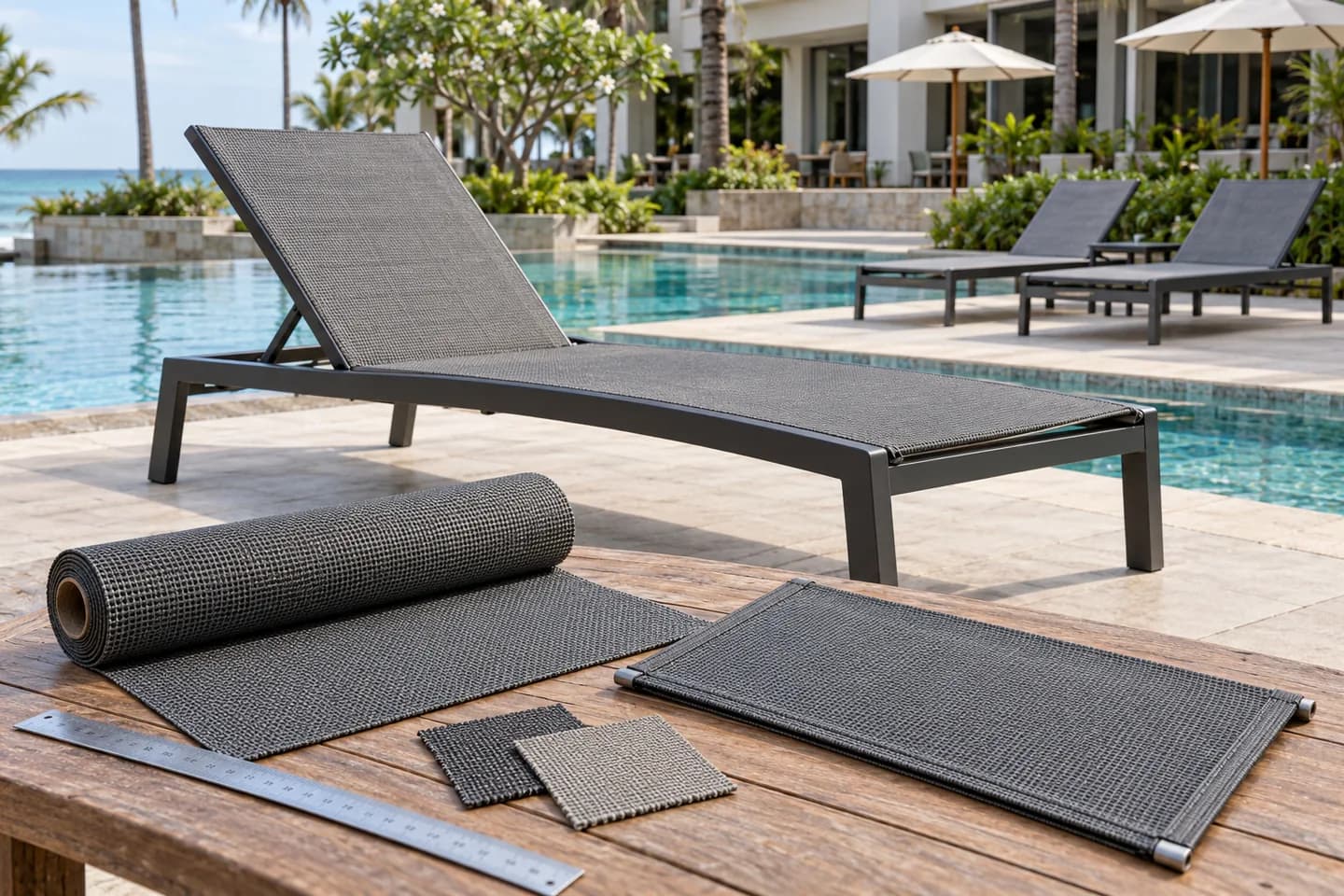
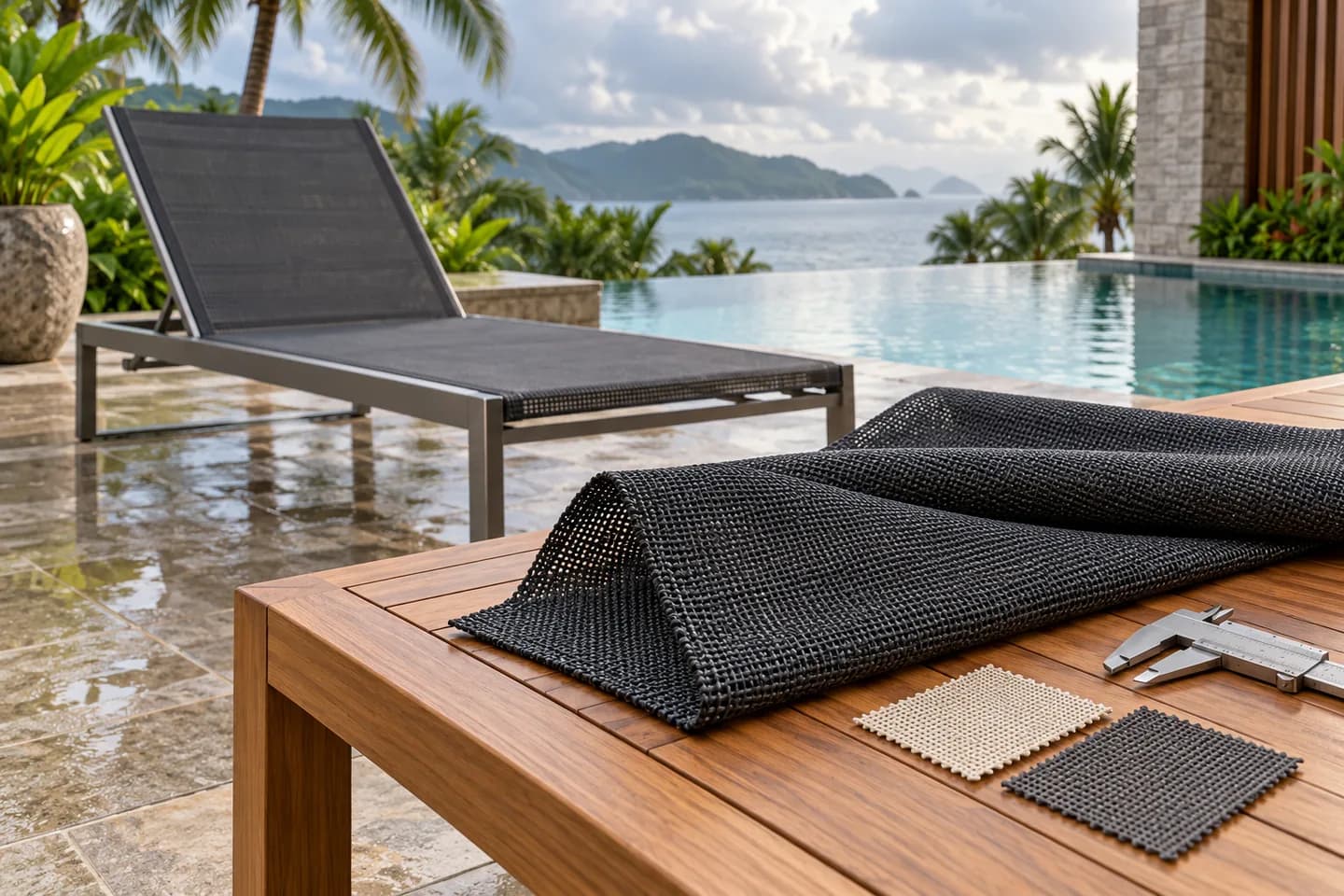
This matters for poolside loungers in Southeast Asia, resort seating in the Caribbean and exterior screens in other warm, wet markets. Their exposures are not identical. Direct sun, rain, shaded dampness, body load, cleaning chemicals and sea spray place different demands on the mesh and on the product built around it.
PVC-coated polyester is a material family, not one universal specification. A mesh that looks appropriate in a hand sample may still be wrong for a tensioned sling, a shade screen or a repeatedly folded component. The buyer's job is to establish the application, evidence and approval route for the exact construction being ordered.
Map the exposure before comparing fabrics
Ask where the material will be installed and how it will be used. “Tropical climate” is too broad to be a purchase specification.
| Site condition | What to record | What the evaluation should emphasize |
|---|---|---|
| Open, sunny pool deck | Direct sun, rainfall, sunscreen contact, seating load and cleaning frequency | Weathering, color, retained strength, sling fit and approved cleaning method |
| Covered but humid terrace | Limited rain, slower drying, low airflow and long periods of occupancy | Surface hygiene, drying opportunity and the effect of sustained tension on the assembled product |
| Coastal installation | All of the above plus possible salt spray and wind-driven moisture | Fabric evaluation and corrosion-resistant frames, fasteners and attachment details |
| Shade or screen system | Tension, wind exposure, edge details and operating cycles | Dimensional behavior, tear resistance, edge construction and system-level approval |
Salt exposure is a separate requirement; it should not be silently included in a generic humidity claim. Likewise, a fabric that works as a screen is not automatically suitable for a chair that supports a person. Our sling-chair mesh selection guide explains the frame and tension questions in more detail.
For the RFQ, specify the destination, exposure, product drawings, attachment method, expected cleaning products and any governing product standard. If the finished product is sold in several markets, separate the requirements that apply to each market.
Verify the construction you are buying
Request a product-specific data sheet rather than a family brochure. Record the polyester yarn construction, PVC coating description, weave pattern, nominal mass, thickness, usable width, color and permitted manufacturing tolerances. Identify the face and direction of the fabric if these affect cutting or appearance. Keep the same product code and sample reference on the quotation, test report, pilot and bulk order.
The open structure is part of the performance decision. It may allow water and air to pass through, but the result depends on the weave, yarn size, finish and how the material is installed. Evaluate it in the actual product: a chair panel may hold water differently at its edges, while a tightly mounted screen may behave differently in wind. Do not substitute a visual estimate of “openness” for application testing.
Ask the supplier to identify which properties belong to the fabric and which can be verified only on the assembled product. Fabric strength is relevant, but it cannot prove the strength of a seam, rail, spline, welded edge or complete chair. Also ask whether the delivered construction and color match the sample used in the reports; a report for a different weave or coating recipe is only background information.
Check strength before and after the relevant exposure
Start with unaged tensile and tear results in both fabric directions. For coated fabrics, ISO 1421 describes tensile testing, including methods for conditioned and wet specimens, and ISO 4674-1 describes constant-rate tear methods. The chosen method, specimen direction, conditioning and units should appear on the report.
Then ask what remains after a defined exposure. ISO 1419 describes accelerated-ageing methods for coated fabrics. A useful comparison identifies the exact ageing procedure and conditions, reports the starting and post-exposure properties, and inspects the material for cracking, hardening, tackiness or coating separation. Decide which observations and retained-property levels are acceptable for your product before the supplier runs the test.
Do not compare two quoted “tensile strength” numbers if one came from a different test method, direction or conditioning state. Do not treat a stated number of laboratory hours as a promised number of outdoor years. Laboratory tests support comparison under specified conditions; a product pilot and field history answer different questions.
For a load-bearing sling, include the finished chair or lounger in the approval plan. The frame, panel geometry, edge construction and installation tension all affect fit and support. A standalone swatch cannot demonstrate how the seat will behave under use.
Look beyond UV claims to wet-weather performance
High sunlight and high humidity often occur together, but a light-only result does not describe a rain-and-sun cycle. Ask the supplier which artificial-weathering method was used and which properties were measured before and after exposure.
ISO 105-B10 covers filtered xenon-arc exposure for textiles with the action of liquid water and water vapour; it can be used to evaluate color and ageing behavior. Depending on the material and question, a supplier may instead propose another relevant weathering procedure. Agree on the exposure conditions, assessment method and acceptance criteria with the testing laboratory or responsible product engineer.
Inspect more than a color grade. Review photographs and observations for uneven fading, surface changes, coating defects and changes in flexibility, then compare mechanical properties where the application requires them. A dark and a light colorway may deserve separate review if both will be used in a highly visible installation.
In a warm climate, touch and appearance also matter. A dark sling left in full sun can feel different from a pale one; the buyer should assess the finished product under realistic exposure instead of relying on color charts. No single fabric report can establish occupant comfort or product safety.
Make coating integrity and fabrication part of the approval
Examine the proposed mesh at cut edges, folds, stitched areas and points that contact the frame. These locations may see concentrated movement or abrasion that a flat specimen misses. If coating adhesion is relevant to the construction, ISO 2411 specifies a method for measuring adhesion strength of coated fabrics. Ask what failure mode the test is meant to detect and whether the specimen represents the delivered material.
Ask the fabricator how the material will be cut, joined and attached. Specify seam or weld details, compatible thread or accessories, edge finish, panel orientation and inspection criteria. A supplier's approval of a roll does not approve every conversion process.
If the product is regularly rolled, folded or tensioned, include those actions in the pilot. Record the original dimensions, mounting tension, visible changes after cycling and any adjustment required. The number of cycles and load conditions should come from the intended use and product design, not from a generic fabric marketing claim.
Plan for drying, cleaning and mildew control
Mesh can shed water through its openings, but dirt, skin oils, sunscreen and sheltered wet areas still need a cleaning plan. Even a fabric sold with antimicrobial protection is not maintenance-free. Phifer's outdoor-fabric cleaning guidance tells owners of its treated fabrics to clean regularly, rinse away cleaner and allow airflow while drying. That guidance applies to Phifer's products; obtain the proposed supplier's approved cleaning instructions for your actual fabric.
Before approval, test the cleaning process the operator will really use. Name the detergent or disinfectant, concentration, contact time, brush or cloth, rinse method and drying conditions. Check for color change, residue, coating damage and changes at seams or attachments. Never assume a bleach concentration permitted for another brand is permitted for this one.
For hospitality or public-use furniture, ask who will clean the products, how often and where they can dry. The maintenance plan is part of the purchase decision. A fabric that passes a laboratory stain test may still be impractical if the installed product traps moisture or cannot be cleaned with the site's approved chemicals. Our outdoor mesh care guide offers a handover checklist for the operating team.
Read the report, not just the pass mark
Request a compact evidence pack for the specific construction and color being quoted:
| Evidence | Check before accepting it |
|---|---|
| Product identification | Code, color, weave, coating, batch or sample traceability |
| Test method | Standard and edition, method variant, specimen direction and conditioning |
| Exposure record | Light, wetting or ageing conditions, duration and any deviations |
| Results | Starting and post-exposure values, units, observations and photographs where useful |
| Acceptance | The buyer's agreed limits and the finished-product decision they support |
| Laboratory details | Testing date, issuer, sample source and report number |
A published method tells you how a property was tested; it does not set a universal pass level for every lounge chair, shade system or country. The responsible product team must define acceptance against the intended use and any applicable finished-product requirements. If a supplier cannot connect a report to the proposed fabric, request a matched sample and an agreed test plan.
Run one finished-product pilot before bulk approval
Use the intended production fabric and conversion method in a representative chair, screen or other finished item. Install it in the intended orientation and document the assembly. Ideally, review the pilot with the buyer, fabricator and person responsible for product safety.
Check the features that matter in a hot, humid setting: fit after installation; tension and comfort where people sit; drainage and drying after wetting; appearance after sun exposure; cleaning results; and condition at edges and attachment points. Include any required load or system tests defined by the finished-product engineer. Compare the pilot with the approved swatch and record changes before releasing the main order.
Keep one physical reference sample and the signed specification for later batches. Record whether any change in yarn, coating, weave, width, color process or fabricator requires reapproval. This helps prevent an apparently similar replacement material from being substituted without review. For projects with multiple colors, use a documented color matching and sample approval process.
Send an RFQ suppliers can answer consistently
Give each supplier the same facts and ask them to identify assumptions or exceptions:
- Finished product and use: sling chair, lounger, screen or another application; drawings and attachment details.
- Installation location: country or region, open sun or covered exposure, rainfall, sea spray and storage conditions.
- Proposed material: construction or reference sample, colors, usable width, roll quantity and fabrication method.
- Evidence needed: relevant baseline and post-exposure tests, sample traceability and approved cleaning instructions.
- Approval route: swatch, lab sample, finished-product pilot and who signs off each stage.
- Commercial details: color quantities, destination, delivery schedule, packing and change-control requirements.
Ask the supplier to price the exact scope stated: fabric by the roll, converted panels or a complete product are different offers. The custom outdoor fabric RFQ checklist can help organize the wider quotation. For an AOLEADER material discussion, send the exposure map, product drawing and target quantity through our contact page; the appropriate construction and documentation can then be reviewed against your application.
FAQ
Is all PVC-coated polyester mesh suitable for humid outdoor use?
No. The yarn, coating, weave, finish, fabrication and intended end use vary. Ask for evidence tied to the exact material and test it in the finished product. A mesh suitable for a non-load-bearing screen should not be assumed suitable for a tensioned seat.
Does “mildew resistant” mean we can skip cleaning?
No. Ask what the claim covers, which test supports it and whether the quoted fabric includes any specific treatment. Dirt and moisture can still accumulate on an installed product. Follow the actual supplier's care instructions and provide drainage and drying opportunities.
Can accelerated-weathering hours be converted into years of service?
Not reliably from the hours alone. Results depend on the exposure method, cycle, material and the property measured. Use matched tests to compare candidates, then validate the final product for the intended market and maintenance conditions.
Which test matters most for a poolside sling chair?
There is no single decisive fabric test. Begin with construction identity, baseline and post-exposure strength, color and coating condition, then approve a chair using the actual panel and frame design. The finished assembly must meet the applicable product requirements.
What changes for a coastal project?
Add salt and corrosion exposure to the brief. Evaluate frames, fasteners and attachment details as well as the fabric, and define who is responsible for system-level acceptance. “Humid climate” alone does not capture the coastal requirement.